For a variety of reasons, I lost energy on the Riviera Project for about nine months, but recently it has returned. With the 67,000 words written and the 186 pages currently created, I can estimate that completion will come when I get to at least 78,000 words and 218 pages—and likely more. It has taken over four years to get to this point.
A typically lengthy options list in the fourth generation chapter
The chapters for the fourth (1974-1976) and fifth (1977-1978) generations have gotten a lot of attention. These cars are distinctive in their incredible number of options—the 1976 had 90 individual options. As I say in the text, “If a 1976 Riviera owner tells you their pride and joy is “one of one,” their statement is reasonably likely.”
They’re also challenging because some of the primary sources disagree. For example, if air conditioning was newly standard in 1978, why isn’t that stated in the brochure?
The two most lengthy chapters remain those on the sixth generation (1979-1985) and the seventh generation (1986-1993) cars, which were the Riviera generations longest in production at seven and eight model years, respectively. All together, the chapters on each of the eight generations currently make up 85% of the book.
2022 is ending, so it’s time to assess the overall state of this tiny press for this calendar year.
This was a slow year for J3Studio Press. Despite that, I made a some progress on what will likely be the press’ next book. As of December 2022, the Riviera Project sits at 67,000 words and 186 pages—slight increases over 2021. I still don’t have a title for the book.
I’m continuing to integrate the information from my October 2021 visit to the Sloan Museum in Flint. Over the year, I also spent a lot of time thinking about book formatting.
Finally, the J3Studio Press website continues to get a reasonable amount of hits, though I’ll stand by my observation that it’s hard to build an audience for a small press from nothing.
2021 is ending, so it’s time to assess the overall state of this tiny press for this calendar year.
In the spring, I had a major medical issue that involved surgery and meant little activity for about four months. Despite that setback, I made a lot of progress on what will likely be the press’ next book. As of December 2021, the Riviera Project sits at 66,000 words and 182 pages—substantial increases over 2020, even as the writing got steadily more involved. 2021 was definitely a productive year for writing about the Riviera and its times—even if I still don’t have a title for the book.
I visited the Sloan Museum in Flint in October and spent a few hours in the archives—I’ll finish the blog post on that stop at some point. Suffice to say that some of the sources I viewed and photographed in the archives had me heavily revising various components of the book. Over the year, I also spent a lot of time thinking about book formatting.
Finally, the J3Studio Press website continues to get a reasonable amount of hits, though I’ll stand by my observation that it’s hard to build an audience for a small press from nothing. However, page views were up 7% over 2020.
2020 is (mercifully) over, so it’s time to assess the overall state of this tiny press for this calendar year.
A lot has gotten done, though my internal clock always tells me we’re slow. The Riviera Project currently sits at 53,600 words and 152 pages—substantial increases over 2019, even as writing got harder. 2020 was definitely a productive year of writing.
Over the year, I’ve also spent a lot of time thinking about how to display the Riviera’s exterior color palette. Part of the process has also included unexpected sources, deep dives, and other cars that are part of the story.
Meanwhile, Lincoln Highway 101, Second Edition has continued to find an audience—reinforcing my belief that it was worthwhile to revise it in the first place.
Finally, the J3Studio Press website itself has taken a reasonable amount of hits, though I have discovered that it’s hard to build an audience for a small press from nothing. However, page views were up 13% over 2019.
Writing the Riviera Project has emphasized to me how much of the Riviera’s story is also that of other cars. Of course, the first car to discuss is the 1958 Ford Thunderbird, whose release and success surprised General Motors and directly prompted the Buick Riviera.
Ford began a feasibility study for a four-seat Thunderbird in October 1954. Designated as 195H, the new direction was approved on March 9, 1955. Aside from essentially creating a new market segment, the second-generation Thunderbird was also the first Ford Motor Company vehicle to use unibody construction. This technical innovation allowed it to be astoundingly low for a mass-market late 1950s four-seat coupe—at 52.5 inches, more than half a foot shorter than Ford’s Fairlane 500 Victoria coupe and only one and a half inches taller than Chevrolet’s Corvette sports car.
Rumors of a four-seat Thunderbird started showing up in the press in early June 1957. On Wednesday, October 16, 1957, Ford formally disclosed that the glamorous and acclaimed two-seat Thunderbird would be replaced by a four-seat version for the 1958 model year. The new Thunderbird was unveiled to a select group on New Year’s Eve 1958 at the prestigious Thunderbird Golf Club in Palm Springs, CA. The 1958 didn’t show up at dealers until late in January 1958, with an official introduction on February 13, 1958.
Cover of the 1958 Ford Thunderbird brochure
The first of the four-seat Thunderbirds sold very well, despite a down year for the industry overall and only nine months of production. Ford moved 35,762 hardtop coupes at a base price of $3,631, proving that there was considerable demand for a brand extension well above the previous four-seat top-of-the-line—the $2,435 Victoria hardtop coupe. Indeed, the Thunderbird cost more than many Mercurys in an era when there was usually strong price separation between brands—only the Park Lane models and the Montclair Voyager four-door station wagon were pricier.
At the time, the 1958 was lamented by automotive enthusiasts as a horrible corporate change from the lovely 1955-1957 two-seat convertible, but Ford’s management knew they had made the right decision—sales of the two-seater had peaked at 21,380. General Motors marketers and product planners must have noticed what was going on—and been aware that they had no competitive vehicle. The new Thunderbird was Motor Trend’s Car of the Year for 1958, and it continued to sell well over the next few model years: 57,195 hardtop coupes in 1959 and 80,983 hardtop coupes in 1960.
I’ve managed to publish three travel books over the last 15 years, but now I’m working on an automotive title. Why this particular book? Why the Riviera Project?
The first hint is in the draft dedication:
For my glorious wife, who told me that she always thought I should write books about automobiles
—but there’s more to it. As I write this book, I have not yet owned a Buick Riviera (though I am currently searching for one). However, the Riviera has been on my radar since I was a young child.
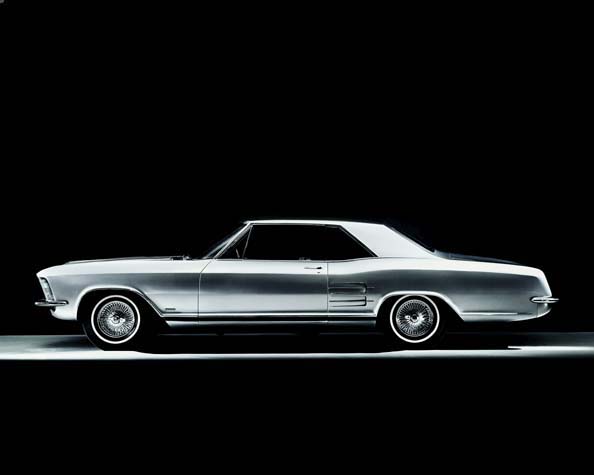
Cadillac La Salle XP-715 prototype
When I was attending elementary school in the late 1970s, a local public library that I visited often had a few books on automotive styling. In one of those books was a grayscale picture of the side profile of a Riviera prototype. I remember to this day the precise point when I became aware of Buick’s coupe—though I can’t find or even identify that book (how does one search for such a thing?). I am quite sure it was the photo shown here, or a variation thereof.
My Riviera predilections became known—and have been known for decades. An encounter with an ex-girlfriend shortly after the eighth generation version was released led to a seemingly out-of-the-blue question: “What do you think of the new Riviera?” she queried. “I really like it.” was my reply. “I thought you would,” she said with a knowing smile.
When Buick announced the end of Riviera production in the fall of 1998, I remember writing an angry email to the corporate office telling them that they were losing their soul. I then inquired with our local Buick dealer about the availability of a Silver Arrow, but all 200 made were already long gone.
Over the (so far) sixteen month process of writing this book, I have found myself becoming steadily more enamored with the romance of the Riviera. I am now rooting for all eight generations—even the ones I was previously disinterested in.
As I do more research for the Riviera Project, I’ve been getting into the weeds with some details. One of the areas that I’ve spent some time researching is early airbags, one example of which showed up in 1974-1976 Rivieras. These driver and front passenger airbags—designated Air Cushion Restraint System (ACRS) by General Motors—were also available in other full-sized Buicks, Cadillacs, and Oldsmobiles over the same three model years. They were marketed as a replacement for shoulder belts, and ACRS cars had only lap belts in the front seat. In 1974, they were also a way to avoid the much-despised and soon to be repealed seat belt starter interlock system.
For the mid-seventies, the Air Cushion Restraint System was bleeding-edge technology, and General Motors spent $80 million on their development. The airbags themselves were dual-stage, which didn’t return to airbag design for almost 25 years and wasn’t mandated until 2007. They were also far more substantial than modern airbags are, with the passenger airbag extending across more than half of the front seat. General Motors piloted the ACRS in 1,000 fleet-purchased Chevrolet Caprices and Impalas in 1973.
Interior of a 1975 Buick Electra 225 with airbags
Choosing the ACRS led to many changes inside the car—the factory fitted a different four-spoke steering wheel with horn buttons mounted on each hub and a substantial padded hub in the center which held the airbag. Further changes located a small storage compartment on the left side of the steering column, moved the glove box to the lower center section of the instrument panel, and both redesigned and relocated the ashtray below the radio.
Only 329 1974 Rivieras—less than 2% of production—were made with the Air Cushion Restraint System, and it seems to have been about the same for other models. General Motors produced a total of 10,321 vehicles with airbags over the three model years, and many that were so equipped sat unsold on dealer lots. In general, the public was not ready for airbags, and the American Automobile Association (AAA) and other similar organizations offered little encouragement, with the AAA claiming that airbags were being sold “irresponsibly and prematurely.”
Bitter in its typical corporate way over the failure of an expensive new technology to find a substantial number of buyers, General Motors would not offer airbags again until the 1988 model year. At that point, driver’s side airbags were offered an option in Oldsmobile’s Delta 88 Royale sedans and coupes. By then, GM was no longer a leader in technology or safety.
Interestingly, the seventies General Motors airbags turned out to be very well built, with substantial longevity. In 1993, the Insurance Institute for Highway Safety crash-tested two of the original 1973 Chevrolet fleet cars. Both cars had over 100,000 miles and were in bad shape otherwise, but all four airbags worked perfectly.
One of the things that has surprised me as I work to write the Riviera Project is the varied sources I’m working with—and not just the usual automotive-centric ones. One of these unexpected sources is The Secret Lives of Color by Kassia St. Clair.
This beautifully laid out little book carefully treats the histories of 75 separate colors, among them Avocado, Gold, Indigo, Taupe, and Violet. It also includes an extensive preface which discusses how we see different shades, the history of artists and pigments, and other topics around color.
I’m using The Secret Lives of Color to get some overall idea of the history of various individual colors and color theory itself. This information provides context for the Buick Riviera’s often spectacular exterior paint colors, which include Seafoam Green, Aqua Mist, Sunset Sage, Medium Sand Gray Firemist, and Dark Jadestone Metallic.
The Secret Lives of Color is available in a hardback from many sources, including Amazon and Barnes & Noble. It is one book I would definitely suggest getting in paper form—making sure the colors were accurate for it was likely demanding.
2019 is over, so it’s time to assess the overall state of this tiny press for this calendar year.
A lot has gotten done, though my internal clock always tells me we’re slow. The Riviera Project currently sits at 34,500 words and 106 pages. 2019 was definitely a productive year of writing, though it slowed toward the end, because of the holidays and some unanticipated (and completely external) issues.
Over the year, substantial progress has also been made with the Riviera Project‘s overall layout and with data display.
I also did a ton of background research on the Riviera, with perhaps the most interesting part of those studies being my attendance at the Riviera Owners Association’s International Meet in June.
Meanwhile, Lincoln Highway 101, Second Edition has continued to find an audience—reinforcing my belief that it was worthwhile to revise it in the first place. I also spent some time recapping some of the basics of the trip Lincoln Highway 101 writes about on this blog.
Finally, the J3Studio Press website itself has taken a reasonable amount of hits, though I have discovered that it’s hard to build an audience for a small press from nothing. I’d tell you the percentage of increase from 2018, but the site took zero actual hits in 2018 …
On the first full day of the 2019 International Meet of the Riviera Owners Association, the final event was a Guided Rallye through Gettysburg and the surrounding country. I do not currently own a Riviera, and, though other cars were explicitly welcomed on the tour, my preference was to be in a Riviera. However, I didn’t know anyone from the ROA either than virtually before attending the meet, so I didn’t think my odds were good of achieving my objective.
As it happened, I met one of my virtual acquaintances from the ROA section of the AACA forums as we were listening to the pre-road tour briefing. Mike offered me shotgun in his striking Aqua Mist 1968 Riviera, and I jumped at the chance. In a total coincidence, his car was on all the meet materials, including the t-shirt. I wonder how many t-shirts I would buy if my car was on them …
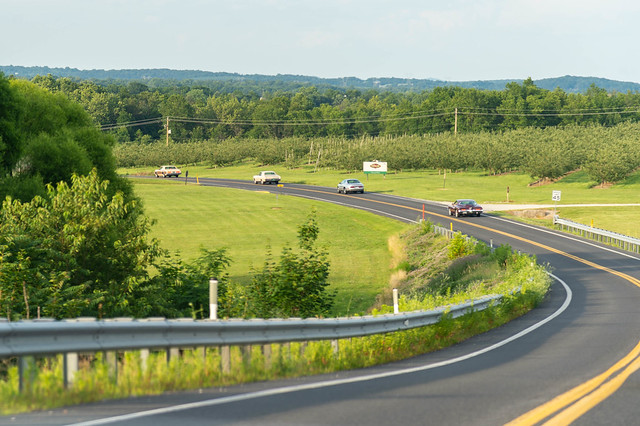
Following four visible Riviera generations on the road tour.
We left the hotel parking lot slowly, with a total of about 17 Rivieras. My number one observation is that the second generation Riviera is a very comfortable car. At no point in our approximately two-hour tour did I feel remotely cramped, despite my 6’2″ and a little over 200 pounds.
Another thing I noted was how much visibility these cars have. I managed to take some decent pictures during the tour, primarily because of the wide views I had available to me in almost all directions.
Finally, it cannot be ignored that Mike’s 1968 is quite spritely. Even with an all-in weight that was likely around 4,700 pounds, The Aqua Zephyr (probably only a week older than I am—another wild coincidence) got up and went when he asked it to.
So, thank you, Mike, for giving me the experience of being in a sixties Riviera driving through the Pennsylvania countryside. I’ll never forget it.






 J3Studio Press