The Curious Case of the First-Generation Airbag

As I do more research for the Riviera Project, I’ve been getting into the weeds with some details. One of the areas that I’ve spent some time researching is early airbags, one example of which showed up in 1974-1976 Rivieras. These driver and front passenger airbags—designated Air Cushion Restraint System (ACRS) by General Motors—were also available in other full-sized Buicks, Cadillacs, and Oldsmobiles over the same three model years. They were marketed as a replacement for shoulder belts, and ACRS cars had only lap belts in the front seat. In 1974, they were also a way to avoid the much-despised and soon to be repealed seat belt starter interlock system.

For the mid-seventies, the Air Cushion Restraint System was bleeding-edge technology, and General Motors spent $80 million on their development. The airbags themselves were dual-stage, which didn’t return to airbag design for almost 25 years and wasn’t mandated until 2007. They were also far more substantial than modern airbags are, with the passenger airbag extending across more than half of the front seat. General Motors piloted the ACRS in 1,000 fleet-purchased Chevrolet Caprices and Impalas in 1973.

Interior of a 1975 Buick Electra 225 with airbags

Choosing the ACRS led to many changes inside the car—the factory fitted a different four-spoke steering wheel with horn buttons mounted on each hub and a substantial padded hub in the center which held the airbag. Further changes located a small storage compartment on the left side of the steering column, moved the glove box to the lower center section of the instrument panel, and both redesigned and relocated the ashtray below the radio.

Only 329 1974 Rivieras—less than 2% of production—were made with the Air Cushion Restraint System, and it seems to have been about the same for other models. General Motors produced a total of 10,321 vehicles with airbags over the three model years, and many that were so equipped sat unsold on dealer lots. In general, the public was not ready for airbags, and the American Automobile Association (AAA) and other similar organizations offered little encouragement, with the AAA claiming that airbags were being sold “irresponsibly and prematurely.”

Bitter in its typical corporate way over the failure of an expensive new technology to find a substantial number of buyers, General Motors would not offer airbags again until the 1988 model year. At that point, driver’s side airbags were offered an option in Oldsmobile’s Delta 88 Royale sedans and coupes. By then, GM was no longer a leader in technology or safety.

Interestingly, the seventies General Motors airbags turned out to be very well built, with substantial longevity. In 1993, the Insurance Institute for Highway Safety crash-tested two of the original 1973 Chevrolet fleet cars. Both cars had over 100,000 miles and were in bad shape otherwise, but all four airbags worked perfectly.


35,000 Words and Nowhere Near Completion

I recently passed 35,000 words on the Riviera Project, and with that came the realization that I am nowhere near complete. Looking from the current 36,700 words and 112 pages, I can estimate that completion looks like at least 43,300 words and 132 pages—and likely more.

1966 Riviera brochure picture

Progress is undoubtedly being made; I’ve gotten a lot of work done on the chapter that covers the second-generation cars that were sold in the 1966 through 1970 model years. These interesting cars were very popular when new, with almost a quarter of a million sold over five years. I secured a scenic ride in a 1968 last year at the Riviera Owners Association International Meet in Gettysburg, PA, and came away quite impressed.

The second-generation story isn’t merely interesting for the Riviera itself. Part of the story is the arrival of new direct competition over those years; the 1966 Oldsmobile Toronado, the 1967 Cadillac Eldorado, and the 1969 Lincoln Continental Mark III. That’s not even considering the attacks from below from the Chevrolet Monte Carlo and Pontiac Grand Prix—and a substantial revision of the Ford Thunderbird. This makes this chapter a question of balance; the primary story remains the Riviera, but the context of its competitors is important.

It’s Been Slow …

The truth is that I’ve made little progress on the Riviera Project in the last two months—a combination of work, travel, and the holidays have slowed things to a crawl.

Things haven’t been all quiet: I have managed to substantially improve the readability and space utilization of the option tables. I’ve also gotten a better handle on mapping the exterior colors.

I’ve also done some more statistical research. I plotted Riviera prices from 1963 through 1999 against monthly changes in the Consumer Price Index (CPI). Unsurprisingly, the sixth-generation convertibles were the most expensive Rivieras of all, with the 1983 being the absolute peak. What did surprise me was that the 1999 was the most costly coupe even when adjusting for CPI. In constant dollars, the 1974 was the least expensive.

I have hopes of making some more progress before the end of the calendar year. We’ll see what happens.

30,000 Words In

A few days ago, I made it to 30,000 words in the Riviera Project. I’ve made a few more design decisions, including solving a basic book formatting issue that had been bothering me for months.

I’ve been getting more of the option tables done, which only reveals how inconsistent some of the data is. I’ve also become resigned to the statement under Selected Available Equipment in many Buick brochures:

This is a partial list.
See your dealer for details.

One thing that helps with getting accurate options data is scans and photos of the original window labels (the famous Monroney sticker), which sometimes turn up in the strangest places. I’ve gotten to the point where I hope for a heavily optioned car when I do find a window sticker—it’ll give me more data!

Options available in a Riviera of any generation are somewhat strange to our modern eyes, where reduced choice is often the watchword. Even at the very end in 1999, the Riviera was available with 12 exterior colors, six optional accent stripe colors, and five interior colors. Contrast that with Buick’s current top-of-the-line car, the 2019 LaCrosse sedan: 10 exterior colors, no accent stripes, and four interior colors.

A few statistics while we’re at it: revision 12 of the book sits at 106 pages. The two longest chapters are on the sixth generation and the seventh generation cars. Unsurprisingly, by far the most pages per year are for the first generation. The eight chapters on each generation currently make up 82% of the book.

Mid-July Status Update

After returning from the delightful Riviera Owners Association’s International Meet in Gettysburg last month, I’ve struggled just a little to translate my post-event excitement into action. The Riviera Project progresses, but not as quickly as I’d like.

As I look back, one of the things the meet did provide me with was a lot of context around various Rivieras and their features. One small example: photographs from period brochures don’t give a great sense of how the fourth generation (1974-1976) Rivieras integrated their high-mounted taillights.

High-mounted taillights on a fourth generation Riviera

At first, I wasn’t sure if there would be any of the fourth generation Rivieras at the meet—there are a lot less of them being collected than the 1973 and prior cars. However, on Wednesday evening I came out to my car to see a handsome Judicial Black (oh, those bicentennial Buick color names) 1976 parked next to it. So I got some good pictures and, more than that, I got a good overall feel for these cars—I don’t believe I’d seen one in decades.

This example also speaks to the value of attending something like the ROA’s International Meet. Information about some parts of the Riviera’s history is readily available. However, other parts such as the 1974-1976 cars are not nearly as well-covered.

Some statistics for the Riviera Project; as of this morning, we’re at 27,000 words and 81 pages.

Experiences Matter: An Evening Road Tour in a 1968 Buick Riviera

On the first full day of the 2019 International Meet of the Riviera Owners Association, the final event was a Guided Rallye through Gettysburg and the surrounding country. I do not currently own a Riviera, and, though other cars were explicitly welcomed on the tour, my preference was to be in a Riviera. However, I didn’t know anyone from the ROA either than virtually before attending the meet, so I didn’t think my odds were good of achieving my objective.

As it happened, I met one of my virtual acquaintances from the ROA section of the AACA forums as we were listening to the pre-road tour briefing. Mike offered me shotgun in his striking Aqua Mist 1968 Riviera, and I jumped at the chance. In a total coincidence, his car was on all the meet materials, including the t-shirt. I wonder how many t-shirts I would buy if my car was on them …

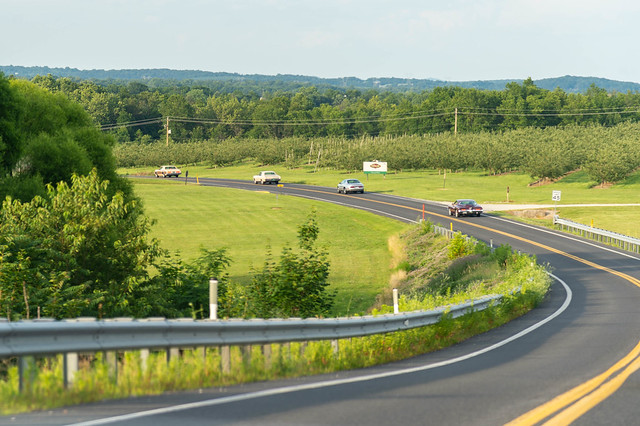
Following four visible Riviera generations on the road tour.

We left the hotel parking lot slowly, with a total of about 17 Rivieras. My number one observation is that the second generation Riviera is a very comfortable car. At no point in our approximately two-hour tour did I feel remotely cramped, despite my 6’2″ and a little over 200 pounds.

Another thing I noted was how much visibility these cars have. I managed to take some decent pictures during the tour, primarily because of the wide views I had available to me in almost all directions.

Finally, it cannot be ignored that Mike’s 1968 is quite spritely. Even with an all-in weight that was likely around 4,700 pounds, The Aqua Zephyr (probably only a week older than I am—another wild coincidence) got up and went when he asked it to.

So, thank you, Mike, for giving me the experience of being in a sixties Riviera driving through the Pennsylvania countryside. I’ll never forget it.

Spending Some Time With the Actual Subject

I’m off this morning to do some true primary research for the Riviera Project. By total coincidence, the Riviera Owners Association’s annual International Meet is in Gettysburg, PA this year. That’s only about two and a half hours away, so it seemed fairly apparent that I should make the time to attend.

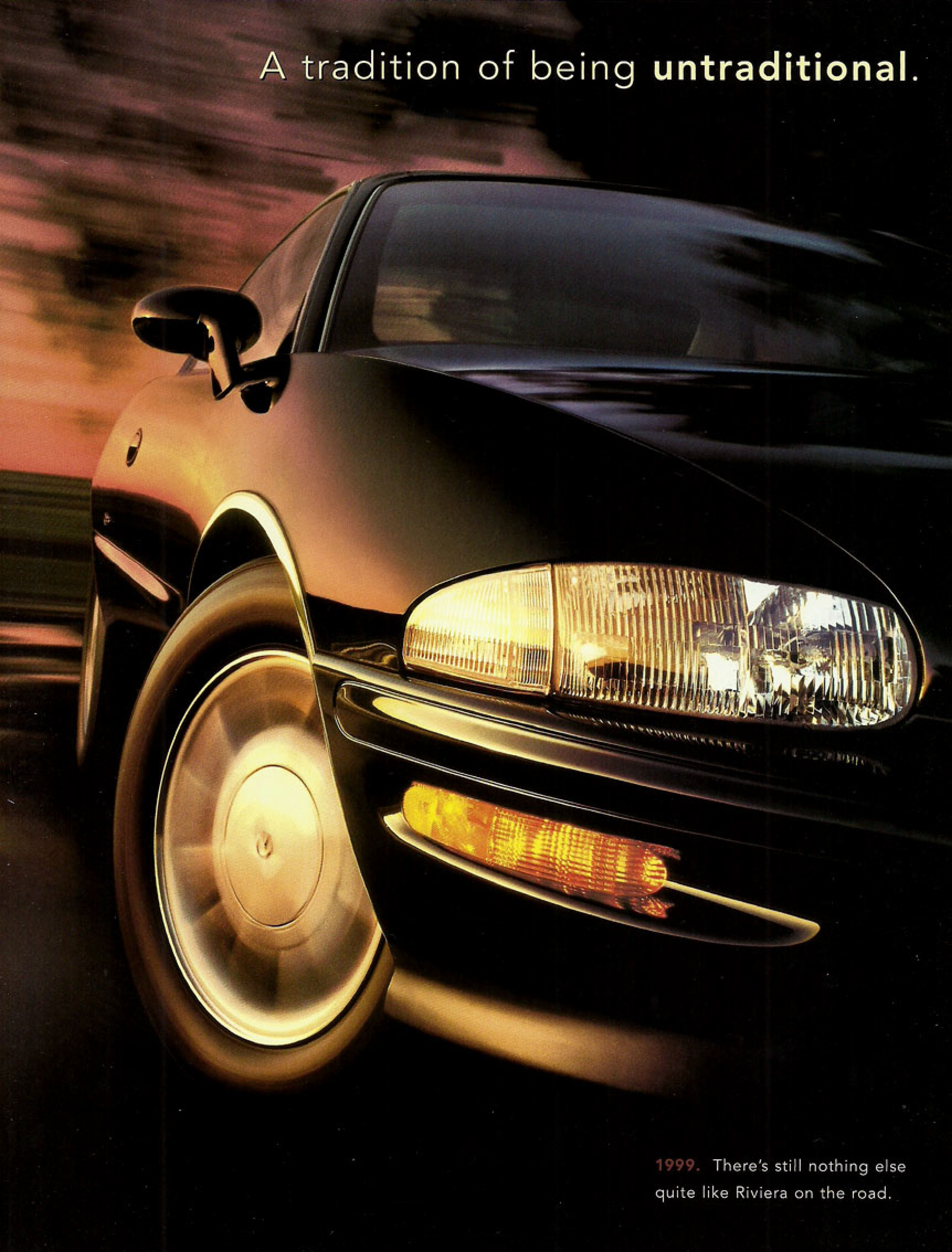
Page from 1999 Buick Riviera brochure

The meet’s organizers are expecting over 100 Rivieras by the time everyone who has registered arrives. From the early photos posted on the meet’s thread on the AACA forums, I can already see six out of the eight generations represented—the fourth (1974-1976) and fifth (1977-1978) generations have yet to make an appearance.

I see this as a great chance to immerse over the next two-and-a-half days. I’ve made some acquaintances on the ROA portion of the forum, but there’s nothing liking talking to folks in person—and, of course, seeing the cars.

25,000 Words In

Yesterday I made it to 25,000 words in the Riviera Project. It’s been slower going than I expected, but the results are satisfying. I’ve also made a couple of design decisions, moving to separate tables for options (and learning how to create tables in InDesign) and refining my chapter headings.

I continue to learn a lot, both about the Riviera itself and about all the context around it. I’m also learning that accurate data will be a problem, but for different reasons. With the earlier cars, it’s disagreements about the data while with the newer cars, it’s often a lack of any data at all—especially for the seventh and eight generation Rivieras.

A few statistics while we’re at it: the book sits at 75 pages. The longest chapter so far is on the seventh generation cars, which makes sense since—at nine years—they were the longest-lived generation. The eight chapters for each generation currently make up 81% of the book.

Inspirations—Viewing the Buick Y-Job in Person

The Buick Y-Job is often described as one of the first—if not the first—concept cars. Designed by stylist George Snyder to show the late-1930s vision of GM design head Harley Earl, the long and low convertible had power windows, wraparound bumpers, and flush door handles. Its powered convertible top was concealed by a metal deck when retracted, and it lacked the running boards that were standard issue in 1938. Finally, the Y-Job had power-operated hidden headlamps—likely influenced by the manually-operated hidden Stinson lights in the mid-1930s Cord 810/812.

Unlike many concept cars that followed, all the features shown in the Y-Job were functional—Harley Earl drove it regularly until about 1951. This extravagance was made at least a little easier by the fact that the Y-Job used the same Dynaflash 141 bhp 5.2 liter/320 ci straight-8 as Buick’s Series 60 Century, Series 80 Roadmaster, and Series 90 Limited cars did in 1938 and was built on a stretched Century chassis.

1938 Buick Y-Job. Photo courtesy of Buick.

Over the years, I viewed many photographs of the Y-Job, but I never expected to see it in person. However, in 2011 I was able to visit the GM Heritage Center in Sterling Heights, MI. There are many amazing cars in the Heritage Center’s collection, but for me, there were two essentials—with every other one of the 150 or so vehicles on display being a bonus. Those two cars were the Y-Job and the Le Sabre.

I got so close to the Y-Job on that particular day that I could lean directly over the rather basic interior. As expected, the car is heart-stoppingly beautiful—but smaller than it looks in many photographs. At 58 inches tall, the Y-Job is also stunningly low, something George Snyder accentuated by fitting 13-inch wheels instead of the 15-inch and 16-inch wheels that were in common use in the late-1930s.

As I continue my work on the Riviera Project, one of the common threads is the highs and lows of Buick styling over the years. When Buick’s exterior design is differentiating in a positive way, I see it as a spiritual callback to the timeless beauty of the Y-Job.

A Little Further Along

I’ve made some progress on the Riviera Project recently, but I am not as far along as I had hoped to be as April turns into May. The book does continue to form, and I am getting more of a sense of what it may end up being.

Typewriter icon

About a week ago, I pushed past a 20,000 word total for the entire book. I’ve done a good bit of background research over the last few days, including some on the Riviera’s competitors such as the Ford Thunderbird and the Cadillac Eldorado. I’m also continuing to gather relevant material—adding both primary and secondary sources. Finally, I’ve been asking a lot of questions on the Antique Automobile Club of America’s forums.

So, still moving along, but the results are not very visible. Hopefully, I’ll have more to report in a few days.